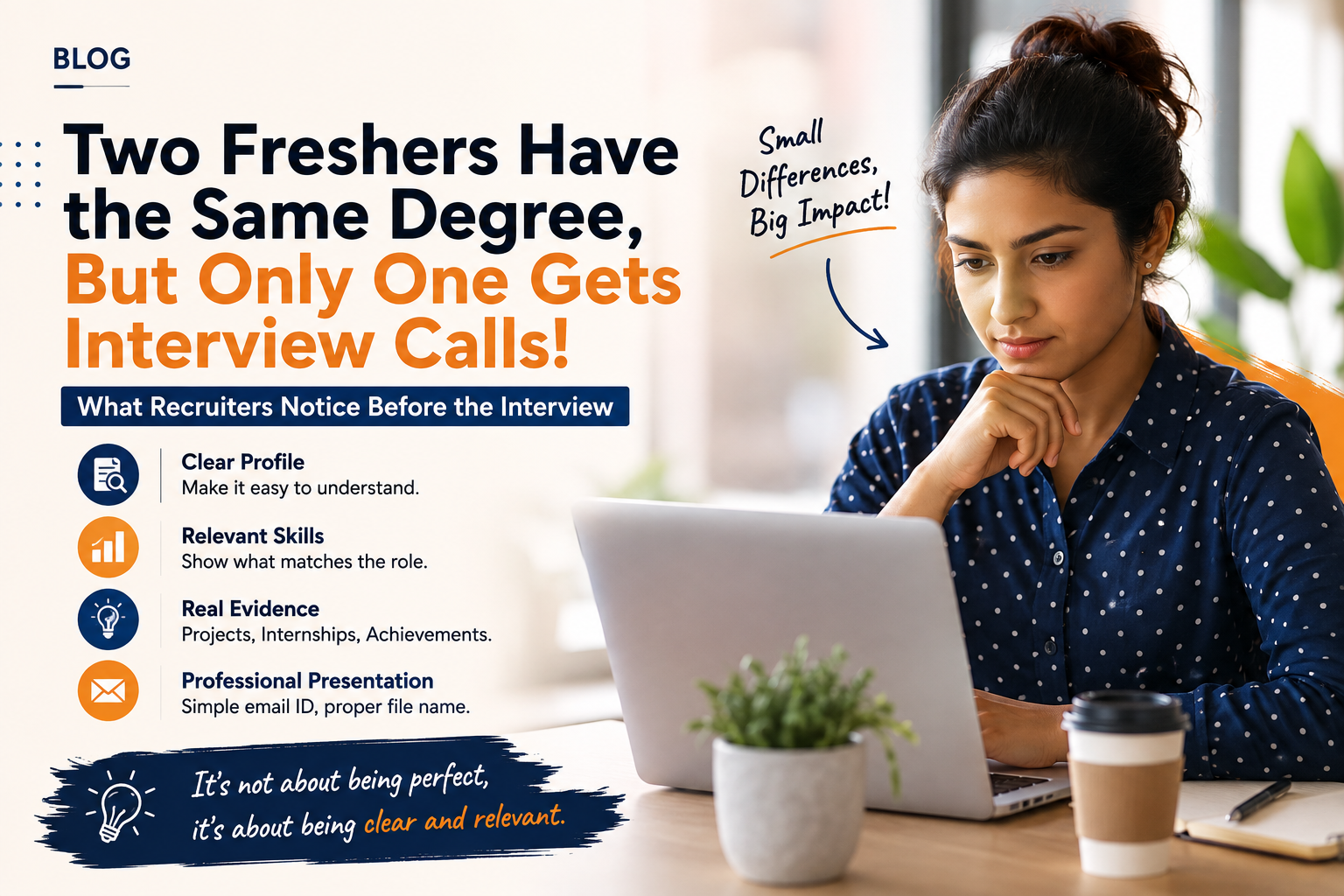
Riya and Karan graduate from the same university in 2026.
Both have B.Com degrees. Neither has full-time work experience. Their marks are similar, and both are applying for entry-level roles in finance, operations and administration.
After one month:
Riya: 18 applications → 5 interview calls
Karan: 22 applications → 0 interview calls
Karan starts thinking:
“Maybe companies don’t hire freshers anymore.”
But that’s difficult to conclude from 22 applications.
Instead, he and Riya exchange resumes and compare exactly what an employer sees before either candidate gets an opportunity to speak.
The differences aren’t dramatic. That’s precisely why they matter.
Their Qualifications Aren’t the Problem
Here is their fictional profile:
| Riya | Karan | |
|---|---|---|
| Degree | B.Com | B.Com |
| Graduation | 2026 | 2026 |
| Marks | 71% | 73% |
| Full-time experience | None | None |
| Internship | 6 weeks | None |
| Excel | Intermediate | Basic |
| College project | Clearly explained | Mentioned only by title |
Karan actually has slightly higher marks.
So why might Riya’s applications communicate more value?
Instead of blaming an algorithm or trying to discover a secret resume trick, let’s open their resumes.
Resume A Says What the Candidate Did
Riya’s resume includes a college project:
Retail Sales Analysis — Final-Year Project
Under it, she writes that she cleaned a sample sales dataset in Excel, used pivot tables to compare monthly performance, created charts and presented observations to her faculty panel.
Nothing extraordinary happened.
She didn’t “transform a ₹100 crore business.”
She simply explains what she genuinely did.
Karan’s resume says:
Project: Study of Retail Industry
That’s all.
A recruiter cannot easily tell whether Karan conducted research, analyzed data, created a presentation or merely participated in a group assignment.
The lesson isn’t to exaggerate projects.
It’s to make genuine work understandable.
A Fresher Can Have Evidence Without Having a Job
Karan believed the experience section had to remain empty because he had never been employed.
But entry-level candidates may have other truthful evidence of skills:
Academic projects
Internships
Volunteer responsibilities
College events
Freelance work
Relevant certifications
Personal projects
Competitions or practical assignments
The key word is relevant.
Organizing a college event may demonstrate coordination. Creating an Excel expense tracker may demonstrate spreadsheet ability. Maintaining social media for a college club may be relevant to an entry-level marketing position.
None should be disguised as full-time employment.
A fresher doesn’t need fake experience. They need better evidence of what they can actually do.
Then They Search Their Resumes for Claims They Couldn’t Defend
Riya’s skills section says:
Excel — Pivot Tables, VLOOKUP, basic charts
Karan’s says:
Excel | Power BI | Tally | Financial Analysis | Leadership | Communication | Management
Karan has opened Power BI twice.
If an interviewer asks him to explain a dashboard he created, he has no good answer.
A long skills list may look impressive for five seconds, but every listed skill creates a possible interview question.
So Karan removes tools he cannot reasonably demonstrate.
A useful rule is:
If you’d be uncomfortable being tested on it tomorrow, reconsider putting it under “Skills” today.
The Job Description Changes the Resume Comparison
Now both candidates find an Operations Associate vacancy.
The employer asks for:
- Graduate qualification
- Excel knowledge
- Documentation ability
- Communication
- Attention to detail
Riya’s resume surfaces Excel, her internship documentation work and a relevant project near the top.
Karan uses the same resume he previously sent for an accounting role.
His first half-page contains an objective paragraph, unrelated certificates and generic personal qualities.
This doesn’t mean every application requires a completely new resume.
It means the most relevant truthful information should be easy to find.
For another job—say, Junior Accountant—the order might change.
The Email Address and File Name Are Tiny Details—Until They Aren’t
Karan’s attachment is:
resume_final_new2(3).pdf
Riya sends:
Riya_Shah_Resume.pdf
Karan uses an old casual email address created during school.
Neither issue proves someone is a bad candidate.
But when you’re applying professionally, removing unnecessary friction is easy.
Use a sensible email address where possible, a clear filename and a commonly readable document format requested by the employer.
Professional presentation doesn’t require an expensive resume designer.
Often it requires fewer distractions.
What About ATS?
Applicants frequently hear:
“The ATS rejected my resume.”
Applicant tracking systems are used by many employers to manage recruitment, but candidates should be careful about treating ATS as a mysterious machine with one universal scoring formula.
Different employers use different systems and hiring processes.
A practical approach is much simpler:
Use clear section headings, describe relevant skills accurately, avoid unnecessarily complicated layouts when applying through online systems, and follow the application instructions.
Most importantly, don’t copy keywords you don’t genuinely possess simply because they appear in the job description.
If a vacancy requires SQL and you don’t know SQL, writing “SQL” repeatedly doesn’t create the skill.
Riya’s Internship Isn’t Automatically More Valuable
It would be easy to conclude:
Riya gets interviews because she has an internship.
But imagine her internship involved almost no relevant work, while Karan independently built three strong accounting projects.
The comparison could change.
Employers may consider combinations of qualifications, skills, experience, role fit and application quality. Different recruiters can also evaluate the same profile differently.
There is no honest formula such as:
Add 5 keywords + one project = interview guaranteed.
Job searching doesn’t work that predictably.
Karan Runs a “10-Second Evidence Test”
Instead of redesigning everything, Karan asks a friend to look at his resume for ten seconds and answer:
What job does this person appear to want?
What can this person actually do?
What evidence supports those skills?
His friend can answer none confidently.
That’s the problem Karan decides to fix.
His revised first section makes three things immediately visible:
B.Com graduate
Excel and accounting fundamentals
Relevant academic projects
He then explains two projects with specific, truthful actions rather than adding more adjectives.
After the Resume Comes the Application Itself
A strong resume cannot rescue every application.
Before applying, Riya also checks:
Is this genuinely an entry-level role?
Do I meet the essential requirements?
Is the location workable?
Does the employer request additional information?
Am I applying through a credible channel?
This prevents her from measuring success purely by application count.
Twenty carefully chosen applications and 100 random “Easy Apply” clicks aren’t equivalent job searches.
The Real Difference Between Our Two Freshers
Riya isn’t necessarily smarter.
Karan isn’t unemployable.
In our fictional example, Riya simply makes it easier for someone who has never met her to understand:
Here is what I’ve learned. Here is what I’ve actually done. And here is why it relates to this role.
That’s what Karan was missing.
His improvement doesn’t guarantee an interview—and no legitimate career article should promise that it will.
But it gives employers clearer information on which to make their decision.
FAQs
Do freshers need work experience to create a useful resume?
Not necessarily. Relevant projects, internships, practical coursework, volunteering and demonstrable skills can provide useful evidence.
Should I add every skill mentioned in a job description?
No. Include skills you genuinely possess. Never claim a qualification or tool simply to match a vacancy.
Does a one-page resume guarantee more interviews?
No. Appropriate resume length depends on the candidate and context. For many freshers, concise presentation can be useful, but there is no guaranteed format.
Is ATS the reason I’m not getting interview calls?
You usually cannot determine that from silence alone. Eligibility, competition, role fit, resume clarity and the employer’s hiring process can all matter.
Should I use the same resume for every vacancy?
Your underlying facts should remain truthful and consistent, but you can emphasize the experience, projects and skills most relevant to each genuine opportunity.