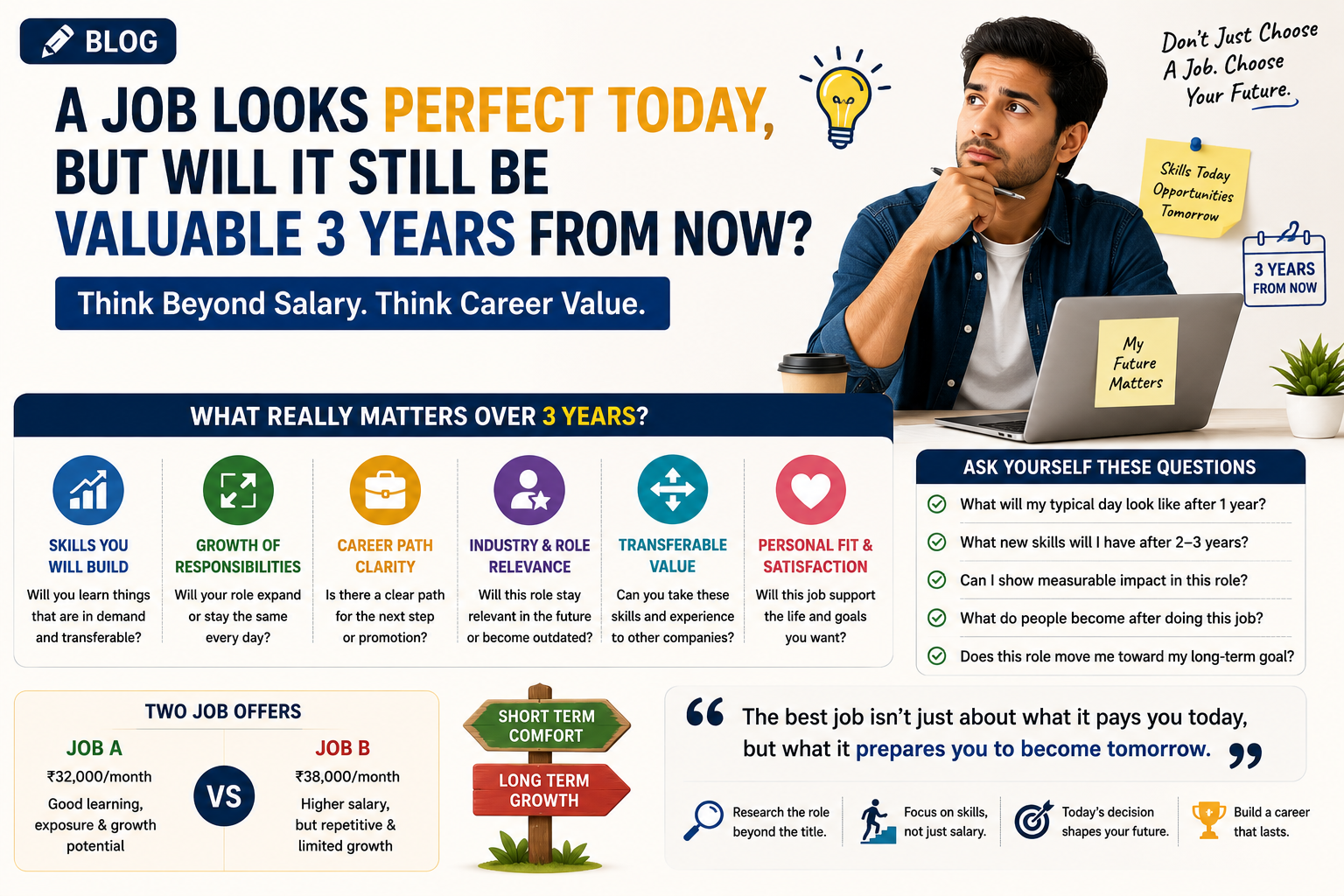
A new job offer can solve an immediate problem.
Better salary. Better title. Better office. Maybe even a well-known company.
But there is another question that rarely appears on an offer letter:
What will this job make you capable of doing three years from now?
Consider two fictional graduates, Neel and Harsh.
Both start their careers in 2026.
Neel accepts a role paying ₹32,000 per month. Harsh chooses another paying ₹38,000.
If salary is the only measurement, Harsh clearly starts ahead.
But their jobs develop very differently.
Three years later, Neel can manage reporting systems, analyze business data, communicate with clients and use several industry tools.
Harsh is still performing almost exactly the same narrow task he learned during his first month.
Suddenly, the original ₹6,000 difference doesn’t tell us much about whose career progressed further.
This isn’t an argument for accepting lower salaries. It is a reason to examine the future value of the work itself.
Don’t Start With the Job Title
Imagine seeing these vacancies:
Business Operations Executive
Management Associate
Process Specialist
Growth Executive
The titles sound promising.
But titles are unreliable indicators of what someone actually does.
A “Business Executive” at one company might analyze reports and coordinate projects. At another, the same title could describe repetitive data entry.
Before getting impressed by a designation, look for verbs in the job description.
Will you:
Analyze? Build? Negotiate? Research? Present? Troubleshoot? Manage? Design? Coordinate?
Or does most of the role involve repeating one tightly defined activity?
The verbs often reveal more about future career value than the title.
The Monday Morning Test
Instead of imagining yourself receiving the offer letter, imagine your 150th Monday morning in that job.
What will you know then that you don’t know today?
Suppose Neel’s first six months involve basic reporting.
By Year 2, he is expected to:
- Build dashboards
- Investigate performance changes
- Present findings
- Coordinate with sales and finance
- Improve reporting processes
His responsibilities expand as his ability grows.
Now imagine Harsh’s role.
Month 1:
Enter information into an internal system.
Month 18:
Enter more information into the same system.
Month 30:
Train a new employee to enter the same information.
Harsh may become extremely efficient at that task.
The concern is not repetition itself—almost every job contains repetitive work.
The question is whether the role also creates new capability over time.
Build a “Skills I Can Take With Me” List
A useful job should ideally leave you with something that remains valuable even if you eventually leave that employer.
Suppose your role teaches you:
Advanced Excel
SQL
Client communication
Financial analysis
Project coordination
Negotiation
Industry compliance
Team management
These abilities may potentially transfer to other roles or employers.
Now compare that with learning only an internal process that exists nowhere outside one organization.
Internal expertise can still be valuable, especially if it leads to advancement within that company.
But it creates a different career profile.
Ask:
If this company disappeared tomorrow, which skills from this job could I explain to another employer?
That’s a powerful career question.
Technology Changes the Job — Not Always by Eliminating It
Artificial intelligence and automation have made candidates understandably curious about whether particular jobs will survive.
But asking:
“Will AI replace this job?”
is often too simplistic.
Jobs contain multiple tasks.
Technology may automate one task, accelerate another and create new responsibilities around reviewing, interpreting or managing the output.
A junior employee who only copies information between systems may face a different future from someone who understands why the information matters and what decisions can be made from it.
Rather than trying to predict exactly which profession will disappear, investigate whether the role helps you move from:
Doing a task → Understanding the process → Solving problems → Making better decisions
That progression can matter regardless of which tools become popular.
Look at the People Two Levels Above You
Here’s an unusual piece of job research.
Instead of researching only the vacancy, investigate the career destination.
If you’re considering an Operations Associate role, what do experienced people in that field eventually become?
Perhaps:
Operations Associate → Senior Associate → Team Lead → Operations Manager
Or perhaps employees typically move into analytics, project management, customer success or another function.
You are not guaranteed to follow anyone else’s path.
But seeing plausible next steps tells you whether the role has somewhere to go.
During an interview, you can also ask:
“How do responsibilities typically change for someone who performs well in this role over the first two or three years?”
The answer can be more informative than asking only when promotions happen.
The 3-Year Career Value Card
Before accepting a role, score it for yourself—not against the internet.
| Question | Weak | Moderate | Strong |
|---|---|---|---|
| Will I learn useful skills? | □ | □ | □ |
| Will responsibilities expand? | □ | □ | □ |
| Are skills transferable? | □ | □ | □ |
| Can I show measurable work later? | □ | □ | □ |
| Is there a plausible next role? | □ | □ | □ |
| Does the work fit my direction? | □ | □ | □ |
This isn’t a mathematical formula.
A job scoring four “Strong” boxes isn’t automatically better than one scoring three.
The card simply forces you to investigate things that a salary number doesn’t reveal.
Sometimes the Higher-Paying Job Is Also the Better Learning Job
There’s an important warning here.
Career advice sometimes creates a false choice:
“Choose money or choose learning.”
Real life isn’t always like that.
A ₹50,000 job might provide better salary and stronger skills than a ₹35,000 alternative.
If so, there may be no meaningful trade-off.
Likewise, don’t accept poor compensation simply because an employer vaguely promises “great exposure.”
Ask what that exposure actually means:
Which tools? Which projects? Which responsibilities? Which training?
Specific answers are more useful than motivational promises.
Your First Job Doesn’t Need to Be Your Forever Job
Choosing imperfectly at age 21, 25 or 30 does not permanently define your career.
People change companies, industries and professions.
The goal is not to predict your entire future before accepting an offer.
It is to avoid evaluating an opportunity using only what is visible today.
Neel and Harsh began by comparing ₹32,000 with ₹38,000.
Three years later, a better comparison was:
What can I do now?
What problems can I solve?
What opportunities am I qualified for next?
Those questions reveal something salary alone cannot.
FAQs
Should I accept a lower salary if the job offers better learning?
Not automatically. Compare compensation, financial needs, learning, working conditions and future opportunities together.
How can a fresher judge future growth before joining?
Study the responsibilities, ask how the role develops, research realistic career paths and understand what skills you’ll actually use.
Are repetitive jobs always bad for career growth?
No. Most jobs include repetition. The concern is whether your responsibilities and capabilities can also expand over time.
Should I avoid jobs that may be affected by AI?
Trying to predict complete job elimination is difficult. Focus on developing transferable skills, domain understanding, judgment and the ability to work effectively with changing tools.
What matters more after three years: job title or skills?
Both can matter, but a title without demonstrable capability may have limited value. Ask what you will actually be able to do, explain and demonstrate after spending several years in the role.