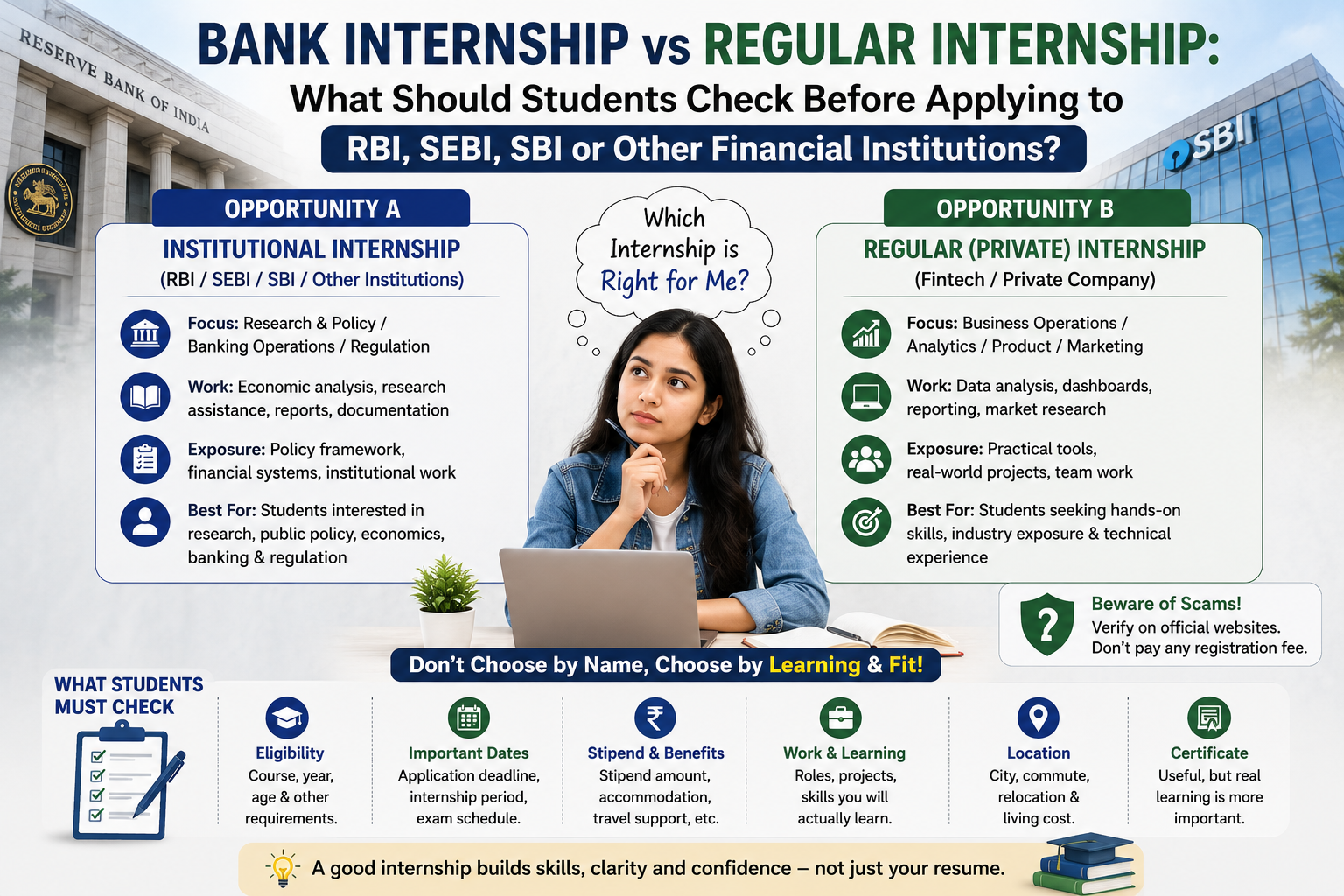
A finance student finds two internship opportunities on the same evening.
The first is a summer internship connected with a major financial institution. The second is a three-month internship at a private fintech company.
The institutional internship sounds more impressive, so the student immediately prefers it.
But there is a problem.
The student hasn’t checked what work the internship actually involves, whether the programme matches their course, whether they meet the eligibility conditions, or what they want to learn from those three months.
An internship should not be chosen only because a famous name will appear on your CV.
For students interested in banking, economics, finance, law, data or public policy, here’s a better way to evaluate opportunities.
Start With the Work, Not the Logo
Suppose Ananya, a postgraduate economics student, finds these two fictional opportunities:
Opportunity A: Internship with a well-known financial institution, involving research assistance and economic analysis.
Opportunity B: Internship with a smaller fintech company, involving customer data analysis, Excel dashboards and reporting.
Which is better?
There isn’t enough information to answer.
If Ananya wants to pursue economic research, Opportunity A may fit beautifully.
If she wants practical analytics experience for a private-sector career, Opportunity B might give her more relevant hands-on exposure.
The organization’s reputation matters, but the actual work matters too.
“Bank Internship” Is a Very Broad Label
Students sometimes search Google for:
“RBI internship”
“SBI internship”
“SEBI internship”
and assume these opportunities are broadly interchangeable.
They aren’t.
Different institutions perform different functions.
The Reserve Bank of India is India’s central bank. SEBI regulates the securities market. State Bank of India is a commercial banking institution.
An internship connected with each organization can therefore have a very different purpose, eligibility structure and learning environment.
Even within the same institution, programmes can change over time.
Never use an old internship article as proof that applications are currently open.
Ananya Creates a “Learning Return” Sheet
Instead of ranking internships by brand name, Ananya creates a simple table.
| Question | Institution A | Fintech B |
|---|---|---|
| Work related to my course? | High | Medium |
| Hands-on technical work? | Medium | High |
| Research exposure? | High | Low |
| Duration manageable? | Yes | Yes |
| Location practical? | Requires relocation | Remote |
| Stipend available? | Check official notice | Confirmed |
| Useful for my career goal? | High | High |
Notice what isn’t included:
Instagram popularity.
An internship is temporary. Its real return can include skills, exposure, professional habits, feedback and a better understanding of whether you actually like a field.
Eligibility Can Be More Specific Than “College Students Can Apply”
This deserves careful attention with institutional internships.
An official programme may specify conditions involving:
- Undergraduate or postgraduate level
- Particular academic disciplines
- Current year/semester
- Institution recognition
- Minimum duration
- Age, where applicable
- Application window
- Recommendation or authorization from the institution
- Location or department preference
Do not assume that being a B.Com, MBA or economics student automatically makes you eligible for every banking or financial internship.
Read the current programme notice.
If an institution says only students in specified years or disciplines are eligible, enthusiasm cannot replace that requirement.
The Calendar Can Matter More Than the Deadline
Imagine an internship application closes on October 31.
Ananya is eligible, so she applies.
Only later does she notice that the internship period overlaps with her university examinations.
The application deadline wasn’t the problem.
The internship dates were.
Before applying, put these dates side by side:
Application deadline → Internship start → Internship end → College exams → Mandatory attendance → Other commitments
This five-minute check can prevent a difficult decision later.
Stipend Should Be Checked, Not Assumed
A famous organization does not automatically mean a large stipend.
Similarly, an unpaid or lower-paid internship isn’t automatically useless.
Students should check the current official terms to understand whether the internship provides a stipend, reimbursement, accommodation, travel support or no financial assistance.
Then calculate the practical cost.
Suppose an internship provides a hypothetical ₹15,000 monthly stipend, but requires relocation.
Your personal monthly expenses could include:
- Accommodation
- Local transport
- Food
- Travel to the city
- Other living costs
The question isn’t simply:
“How much is the stipend?”
It is:
“Can I realistically participate under these conditions?”
Never borrow money or make expensive relocation arrangements based only on an unofficial internship announcement.
A Certificate Is Not the Main Product
Students frequently ask:
“Will I get a certificate?”
That’s reasonable, but it shouldn’t be the first question.
Imagine Internship A gives you a beautiful certificate after eight weeks of mostly observational work.
Internship B gives you responsibility for cleaning a dataset, preparing a dashboard and presenting findings to a supervisor.
Which experience will be easier to discuss during your next interview?
Potentially Internship B.
Recruiters can ask:
What did you actually do?
A certificate can confirm participation. It cannot replace genuine learning.
Beware of “Guaranteed RBI/SBI Internship” Offers
Financial-sector names can attract scams.
Suppose you receive a Telegram message:
“Guaranteed RBI Internship – Pay ₹2,999 Registration Fee – Limited Seats.”
Do not pay merely because the message contains an official-looking logo.
Go independently to the institution’s official website and verify whether the programme exists and whether the stated application process matches.
Be cautious about sharing:
Aadhaar copies, PAN details, banking information, OTPs or unnecessary personal documents with unknown websites or individuals.
A genuine opportunity should be traceable to a credible source.
The 30-Minute Internship Audit
Before submitting an application, spend 30 minutes answering these questions.
First 10 minutes — Verify
Who is offering the internship?
Is there an official announcement?
Are applications currently open?
Next 10 minutes — Match
Do you satisfy the academic requirements?
Does the work relate to something you want to learn?
Can you commit to the duration and location?
Final 10 minutes — Value
What could you genuinely learn?
Who might supervise the work?
What practical output could you discuss later?
What will participation cost you in time and money?
If you still want the internship after answering those questions, you have a much stronger reason to apply than simply:
“It’s a big-name bank.”
What Ananya Finally Chooses
In our fictional example, Ananya chooses the institutional research internship because she plans to pursue postgraduate research in economics.
Her friend, who wants an analytics career, chooses the fintech opportunity.
Neither made the “better” choice universally.
They chose opportunities aligned with different career destinations.
That’s the useful way to think about internships.
FAQs
Is an RBI, SEBI or SBI internship automatically better than a private internship?
No. Compare the actual programme, work, eligibility, learning opportunity and your career goals.
Are all bank internships paid?
No. Stipend and financial-support arrangements vary. Check the current official programme terms.
Can undergraduate students apply for financial-institution internships?
Some programmes may accept particular undergraduate students while others have different academic requirements. Verify the current official eligibility conditions.
Is an internship certificate enough to help my CV?
A certificate can document participation, but being able to explain your actual work, learning and contribution can be much more meaningful.
Where should I verify an internship?
Start with the institution’s official website or official careers/programme announcement, especially before providing personal information or making any payment.