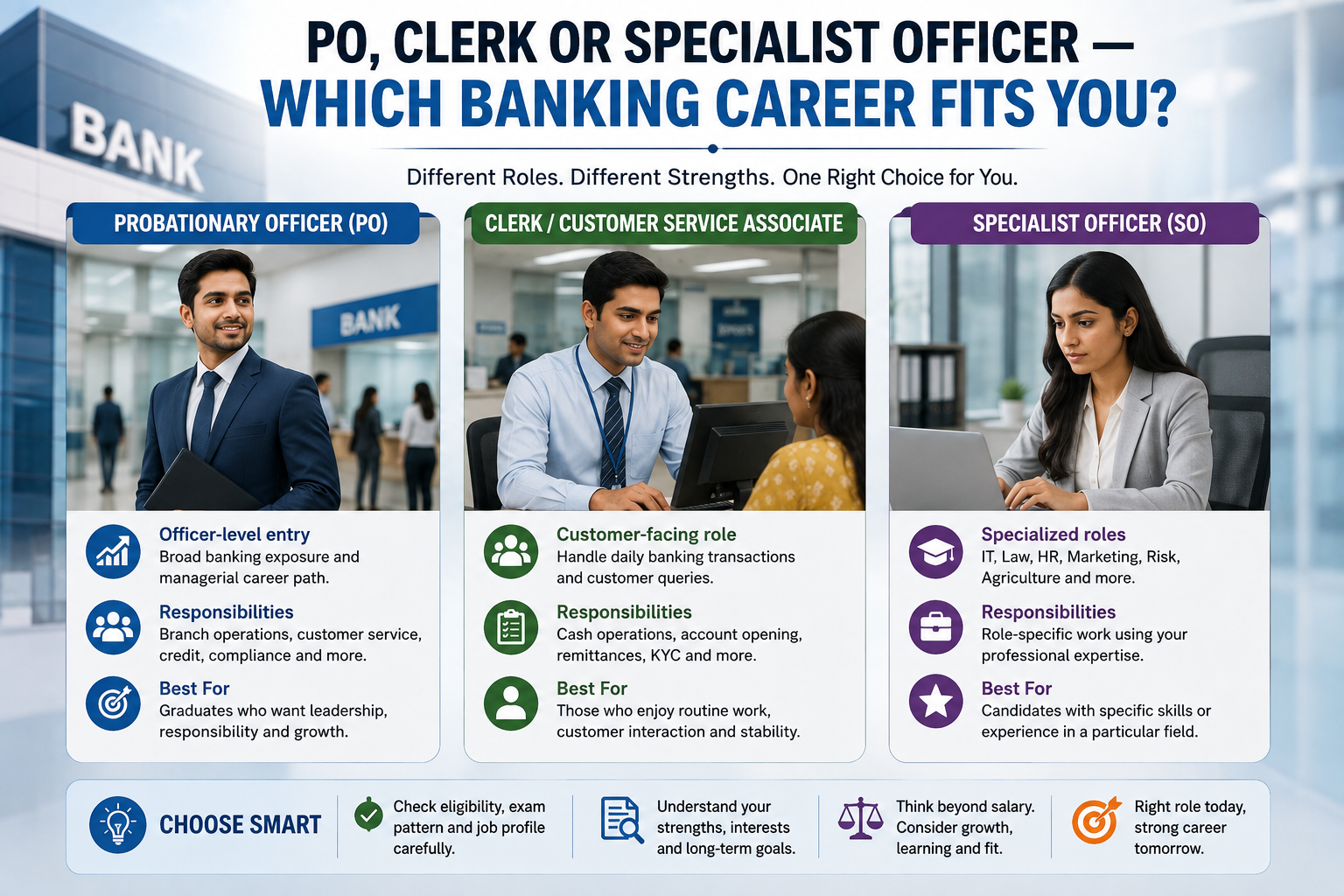
A banking job can look very different depending on the letters written after the bank’s name.
PO. Clerk. SO.
Candidates often compare these roles using salary, exam difficulty or promotion opportunities. But that can miss the most practical question:
What would you actually be comfortable doing after you get the job?
A candidate who enjoys customer interaction may feel differently about banking work than someone who wants to build a career in IT, law, risk or marketing.
So instead of ranking these jobs from “best to worst,” let’s put three fictional candidates inside a bank and see where each one might fit.
Three Candidates, Three Very Different Strengths
Meet Aarav, Mehul and Sana.
Aarav has a general bachelor’s degree. He communicates confidently, enjoys taking responsibility and wants a long-term managerial career.
Mehul is also a graduate. He prefers structured work, customer interaction and operational responsibilities. He isn’t choosing a job primarily because of the designation.
Sana has a technical qualification and two years of cybersecurity experience. She wants to continue using that specialization rather than moving into a broad general-banking role.
All three want to work in banking.
But “I want a bank job” isn’t specific enough to tell them which recruitment deserves their attention.
Aarav Looks at the PO Route
Probationary Officer recruitment is commonly associated with an officer-level entry path.
For example, IBPS conducts Common Recruitment Processes for Probationary Officers/Management Trainees for participating public-sector banks. IBPS official website
Aarav is interested because he wants responsibility and future managerial exposure.
But he shouldn’t interpret “Officer” as meaning that his first day will involve sitting in a private cabin making major decisions.
Actual responsibilities can develop across areas such as branch operations, customer service, banking products, compliance-related work and other assignments depending on the bank and posting.
There can also be transfers and changing responsibilities during a banking career.
For Aarav, the useful question becomes:
Would I still want this job if I removed the word “Officer” from the title and looked only at the responsibilities?
His answer is yes.
That makes PO recruitment worth exploring.
Mehul Stops Calling Clerk a “Lower Choice”
Mehul initially thinks:
“PO is obviously better. I’ll keep clerical recruitment only as backup.”
But that conclusion is based mostly on designation.
IBPS also conducts recruitment for customer-service-associate/clerical cadre positions for participating banks. The exact terminology, participating institutions and requirements should always be checked in the current official notification. IBPS CRP information
The nature of clerical/customer-service work can involve significant interaction with everyday banking operations and customers.
For someone who actually likes that environment, the role should not automatically be dismissed merely because another vacancy has an officer designation.
Mehul therefore changes his comparison.
He stops asking:
Which title sounds more impressive?
He asks:
Which daily work environment suits me better?
That’s a much more useful career question.
Sana Discovers That “SO” Is Not One Job
Sana’s situation is completely different.
She has already spent two years working in cybersecurity.
When she sees Specialist Officer (SO) recruitment, she assumes all SO jobs will suit her.
They won’t.
“Specialist Officer” is an umbrella description that can cover very different specialist positions depending on the recruitment.
Banking organizations may recruit specialists in areas such as:
- Information technology
- Law
- Human resources
- Marketing
- Agriculture
- Risk-related functions
- Other professional disciplines
An IT specialist vacancy and a law-officer vacancy obviously don’t have interchangeable qualifications.
Sana therefore needs to start with the specific specialist post, not the letters “SO.”
Her technical education, experience requirements and eligibility dates must match the actual notification.
The Comparison They Eventually Make
After researching the roles, the three candidates create a simple career map.
| Question | PO | Clerk/CSA | Specialist Officer |
|---|---|---|---|
| Broad banking career? | Strong relevance | Strong operational exposure | More role-specific |
| Specialist degree needed? | Depends on notification | Depends on notification | Often post-specific |
| Customer interaction possible? | Yes | Often significant | Depends on specialist role |
| Managerial responsibility? | Officer pathway | Different cadre/path | Depends on scale/post |
| Best for existing specialization? | Not necessarily | Not necessarily | Potentially |
| Transfers/postings matter? | Can | Can | Can |
This isn’t a ranking table.
There is deliberately no “Winner” column.
The right answer depends on the person reading it.
Now Add the Eligibility Reality
Career preference matters only after eligibility.
Imagine Sana sees an IT Officer vacancy that sounds perfect, but the notification requires a particular technical qualification she doesn’t possess.
Her cybersecurity experience alone may not override an essential educational requirement.
Likewise, Aarav shouldn’t assume that being a graduate automatically makes him eligible for every PO recruitment.
For each actual vacancy, candidates need to verify:
Educational qualification
Age requirement and cut-off date
Experience, if required
Nationality/other eligibility conditions
Selection process
Participating bank or recruiting organization
The current official notification—not an old YouTube video or previous year’s eligibility article—should settle those questions.
What About Salary?
Salary is important, but comparing PO, clerical and specialist positions using one internet number can be misleading.
Compensation can depend on the recruiting institution, cadre/scale, allowances, posting, deductions and the rules applicable at that time.
A headline such as:
“Bank PO Salary ₹75,000!”
doesn’t tell you whether the figure represents basic pay, gross earnings, estimated in-hand salary or total compensation.
If salary affects your decision, read the current recruitment notice and applicable bank/service information rather than treating a search-result headline as guaranteed monthly bank credit.
Try the “Bad Tuesday” Test
Here’s a more realistic way to choose.
Don’t imagine promotion day or your first salary.
Imagine an ordinary Tuesday when work is busy.
PO candidate
Would you still like the career if the day involved responsibility, customer issues, operational targets, documentation and decisions rather than the glamorous image of an officer?
Clerical/CSA candidate
Would you be comfortable handling repetitive operational work and regular customer interaction when the branch is busy?
Specialist candidate
Would you still enjoy using your professional specialization inside a regulated banking environment rather than in a technology company, law firm or marketing agency?
The role whose ordinary days you can accept may tell you more than the role whose best days look impressive.
One Candidate Can Apply for More Than One Route
Choosing a preferred career doesn’t necessarily mean applying for only one type of banking recruitment.
If a candidate independently satisfies the eligibility conditions for multiple recruitments, they may consider more than one opportunity.
But preparation shouldn’t become blind form-filling.
Before spending application fees and preparation time, ask:
Would I actually accept this job if selected?
If the answer is clearly no, applying simply because it is a “bank vacancy” may not be the best use of your time.
The Decision in Our Example
Aarav prioritizes PO opportunities because broad banking responsibility aligns with his career direction.
Mehul gives clerical/customer-service recruitment serious consideration instead of treating it as an inferior title.
Sana monitors relevant specialist vacancies, but only those matching her technical qualifications and experience.
None of them has discovered the “best banking job.”
They have done something more useful:
They identified the banking career that makes sense for their own profile.
FAQs
Is PO always better than a bank clerk position?
There is no universal “better” role. They have different responsibilities, career structures and eligibility conditions. Your priorities matter.
Does SO mean only IT Officer?
No. Specialist recruitment can cover different professional disciplines. Check the exact specialist post in the notification.
Can a general graduate apply for PO recruitment?
Some PO recruitments accept graduates subject to their specified conditions, but always verify the current official notification.
Should salary decide which bank exam I prepare for?
Salary can be one factor, but also consider eligibility, responsibilities, postings, career direction and the type of work you want to perform.
Where should I verify IBPS banking recruitment?
Use the official IBPS website and the relevant current recruitment notification rather than relying solely on third-party summaries.