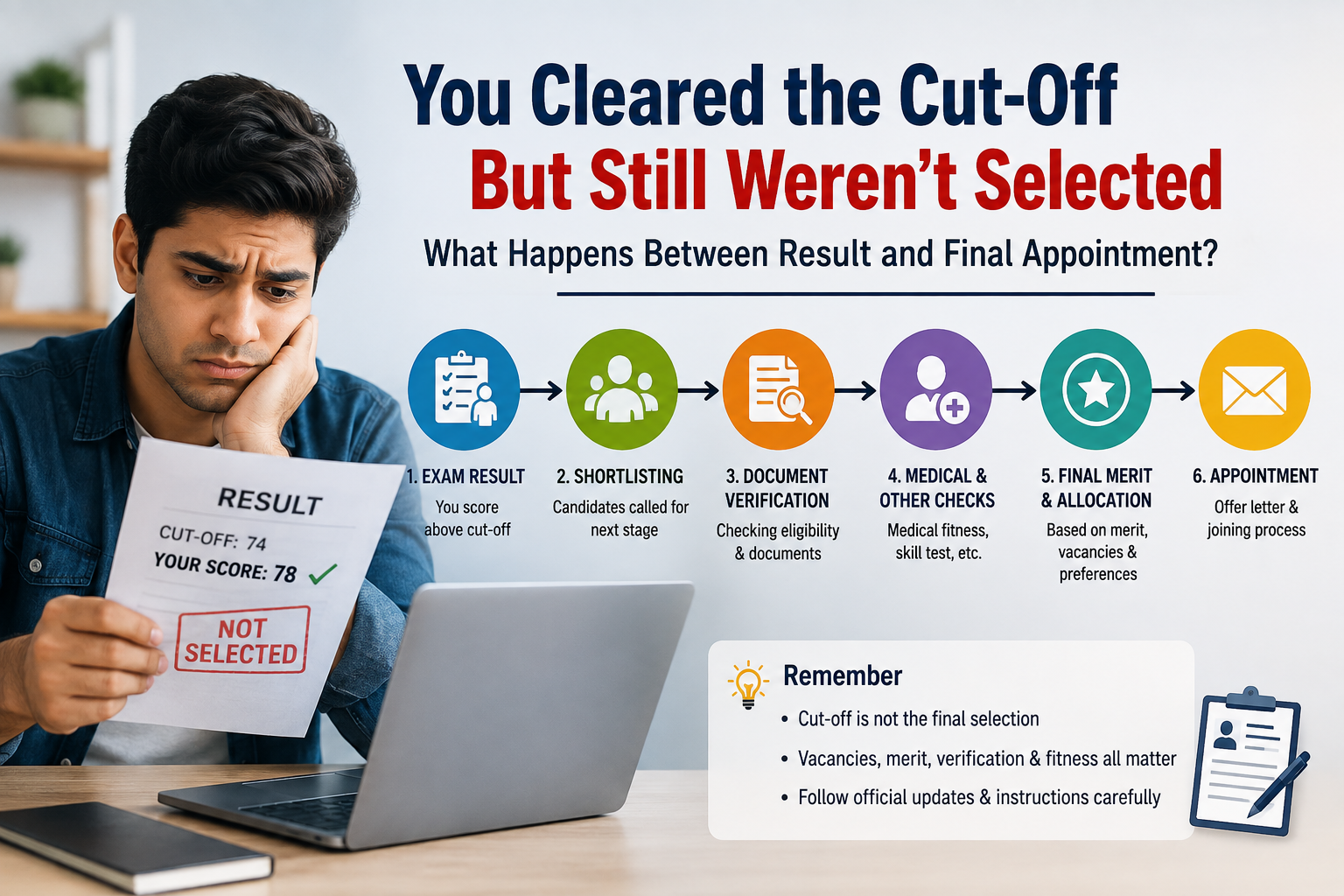
You check the result of a government recruitment exam and feel relieved.
Your score: 78
Published cut-off: 74
You scored four marks above the cut-off.
Naturally, you may think:
“I cleared the cut-off, so I have the job.”
Then the final selection list appears—and your name isn’t there.
This can be confusing, but clearing a cut-off and receiving a final appointment are not always the same thing.
Depending on the recruitment, a cut-off may only determine who progresses to another stage. Final selection can involve merit position, vacancies, category or post allocation, document verification, medical standards, skill tests and other conditions specified in the official notification.
Let’s understand the process through a fictional candidate.
Meet Arjun: 78 Marks, but No Final Selection
Suppose a fictional department recruits 300 candidates.
Arjun applies for one of the posts and scores:
78/100
The published qualifying or shortlisting cut-off relevant to his stage is:
74
So Arjun has successfully crossed that threshold.
But imagine 520 eligible candidates scored 74 or higher.
The department has only 300 advertised vacancies, distributed according to the recruitment rules.
Crossing 74 therefore does not automatically create 520 jobs.
Arjun has cleared an important stage—but the recruitment process may not be finished.
1. First Understand What the “Cut-Off” Represents
Candidates often talk about the cut-off as though every recruitment has only one.
That isn’t necessarily true.
A recruitment process may publish different thresholds for:
- Qualifying an examination
- Shortlisting for the next stage
- Different categories
- Different posts
- Different zones or regions
- Final selection
The exact structure depends entirely on the recruiting authority.
For example, the Staff Selection Commission publishes examination results and cut-off information according to the rules and stages of individual examinations.
So whenever you see a cut-off, ask:
“Cut-off for what?”
That question matters more than the number itself.
2. Minimum Qualifying Marks Can Be Different From Selection Cut-Off
Imagine an examination requires candidates to obtain at least:
40% to qualify
That doesn’t necessarily mean everyone scoring 40% receives an appointment.
Suppose:
50,000 candidates appear
15,000 meet the minimum qualifying requirement
but only:
1,000 vacancies exist
The minimum marks simply determine who satisfies that particular examination requirement.
Selection still depends on the recruitment’s defined process.
This distinction prevents a common misunderstanding:
Qualified ≠ automatically selected.
3. Your Merit Position Can Matter
Return to Arjun.
He scored 78.
Another candidate scored 84.
Another scored 91.
If final selection depends on merit and there are limited vacancies, the relative position of eligible candidates becomes important.
Here’s a simplified illustration:
| Candidate | Score | Above 74 Cut-Off? | Final Outcome |
|---|---|---|---|
| Meera | 91 | Yes | Selected |
| Ravi | 84 | Yes | Selected |
| Arjun | 78 | Yes | Not selected |
| Neha | 73 | No | Did not clear stage |
These results are entirely fictional.
The table simply shows why being above a threshold does not necessarily guarantee a place within the available vacancies.
4. Total Vacancies May Not Be Your Vacancy Pool
A recruitment advertisement might announce:
2,000 vacancies
But those positions may be distributed by the rules of that recruitment across:
posts, categories, states, regions, zones or disciplines.
Suppose Arjun applied specifically for Post A in Region X.
The headline says:
2,000 total jobs
but Post A in Region X may represent only a portion of them.
Candidates should therefore read the detailed vacancy table rather than assuming they are competing equally for every advertised position.
5. Post Preferences Can Affect Allocation
Some multi-post recruitments ask candidates to submit preferences.
Imagine Arjun selected:
Preference 1: Inspector
Preference 2: Assistant
Preference 3: Clerk
Another candidate with a higher merit position has the same preferences.
Final allocation can depend on the specific recruitment’s combination of:
merit + eligibility + available vacancies + preferences + applicable rules.
This is why two candidates who both clear an examination may eventually receive different posts—or one may not receive an allocation.
Never submit post preferences casually without understanding what each position involves.
6. Another Selection Stage May Still Remain
A written-exam cut-off can sometimes be only the beginning.
Depending on the recruitment, later stages might include:
- Second examination
- Interview
- Skill test
- Typing test
- Physical test
- Document verification
- Medical examination
For example, different Railway Recruitment Boards recruitments can use different selection processes depending on the post.
Therefore:
“I cleared CBT”
does not automatically mean:
“I completed the recruitment process.”
Always check the official selection stages for your exact notification.
7. Document Verification Can Change the Outcome
Suppose Arjun reaches document verification.
His examination performance is sufficient, but the post requires the essential qualification to have been completed by:
June 30
His final result was issued on:
July 15.
If the official rules required candidates to possess that qualification by June 30, his examination marks cannot fix the eligibility problem.
Other issues may involve documents relating to:
- Educational qualification
- Age
- Category
- Experience
- Identity
- Required certificates
This is why candidates should verify eligibility before applying, rather than assuming an accepted application proves eligibility.
8. Medical or Physical Standards May Matter for Certain Posts
Some jobs have prescribed physical or medical requirements.
A candidate can perform extremely well academically and still need to satisfy those standards.
This is particularly relevant to certain railway, police, defence and operational posts.
However, don’t apply one job’s medical or physical standard to another.
Always use the requirement specified for the exact post and recruitment.
9. A Result List Can Also Be Provisional
Seeing your roll number in a result PDF is excellent news—but read the heading and notes carefully.
The document may say:
“Candidates shortlisted for document verification”
rather than:
“Candidates finally appointed.”
Likewise, a final result can still be subject to verification or other conditions specified by the recruiting authority.
The safest habit is to read the explanatory notes accompanying the result instead of relying on a social-media post saying:
“Final Result Out!”
Infographic: From Application to Appointment
A government recruitment may broadly look like:
APPLICATION
↓
ELIGIBILITY SCREENING
↓
EXAM / STAGE 1
↓
CUT-OFF / SHORTLIST
↓
ADDITIONAL TESTS
If applicable
↓
MERIT / ALLOCATION
↓
DOCUMENT VERIFICATION
↓
MEDICAL / OTHER CHECKS
If applicable
↓
FINAL RESULT
↓
APPOINTMENT PROCESS
Not every recruitment follows this exact sequence, but the infographic shows why crossing one cut-off can be only one milestone.
What Should You Check If You Cleared the Cut-Off but Weren’t Selected?
Don’t immediately assume there was an error.
Check:
1. Which cut-off did you clear?
Was it qualifying, stage-wise or final?
2. What was your merit position?
Where available, examine the official result details.
3. Which post/category/region applied to you?
Don’t rely solely on total vacancies.
4. Were additional stages involved?
5. Did you satisfy every eligibility and documentation requirement?
6. What does the official result notice actually say?
If you believe there is a genuine discrepancy, use the recruiting authority’s official representation or grievance mechanism where one is provided.
Final Takeaway
Scoring above a government recruitment cut-off can be an important achievement.
But it does not always guarantee appointment.
A cut-off may simply determine who advances to the next stage, while final selection can depend on vacancies, merit, post preferences, eligibility, documents and additional assessments.
Instead of asking:
“I crossed the cut-off—why didn’t I get the job?”
first ask:
“Which stage did this cut-off qualify me for, and what did the official notification require after that?”
That question gives you a much clearer picture of your actual recruitment status.
FAQs
Does clearing the cut-off guarantee a government job?
Not necessarily. It depends on what the cut-off represents and the remaining selection stages.
Can I score above the cut-off and still not appear in the final list?
Yes. Limited vacancies, merit position, post allocation and other recruitment-specific conditions can affect final selection.
Is the qualifying mark the same as the final cut-off?
Not always. Minimum qualifying marks and selection/shortlisting cut-offs can serve different purposes.
Does document verification happen after selection?
The sequence varies. In many recruitments, document verification is part of the selection process and candidature remains subject to eligibility verification.
Where should I check the correct cut-off?
Use the official result notice and recruiting authority’s website for your specific examination rather than relying only on third-party job portals or social-media posts.